

November 27, 2026
You Asked, Our Audiologist Answers | Series
Can we still benefit from hearing care, including hearing aids, at 80, 90 or even 100?
Absolutely!
This is a question that many older adults and their families often ask us.
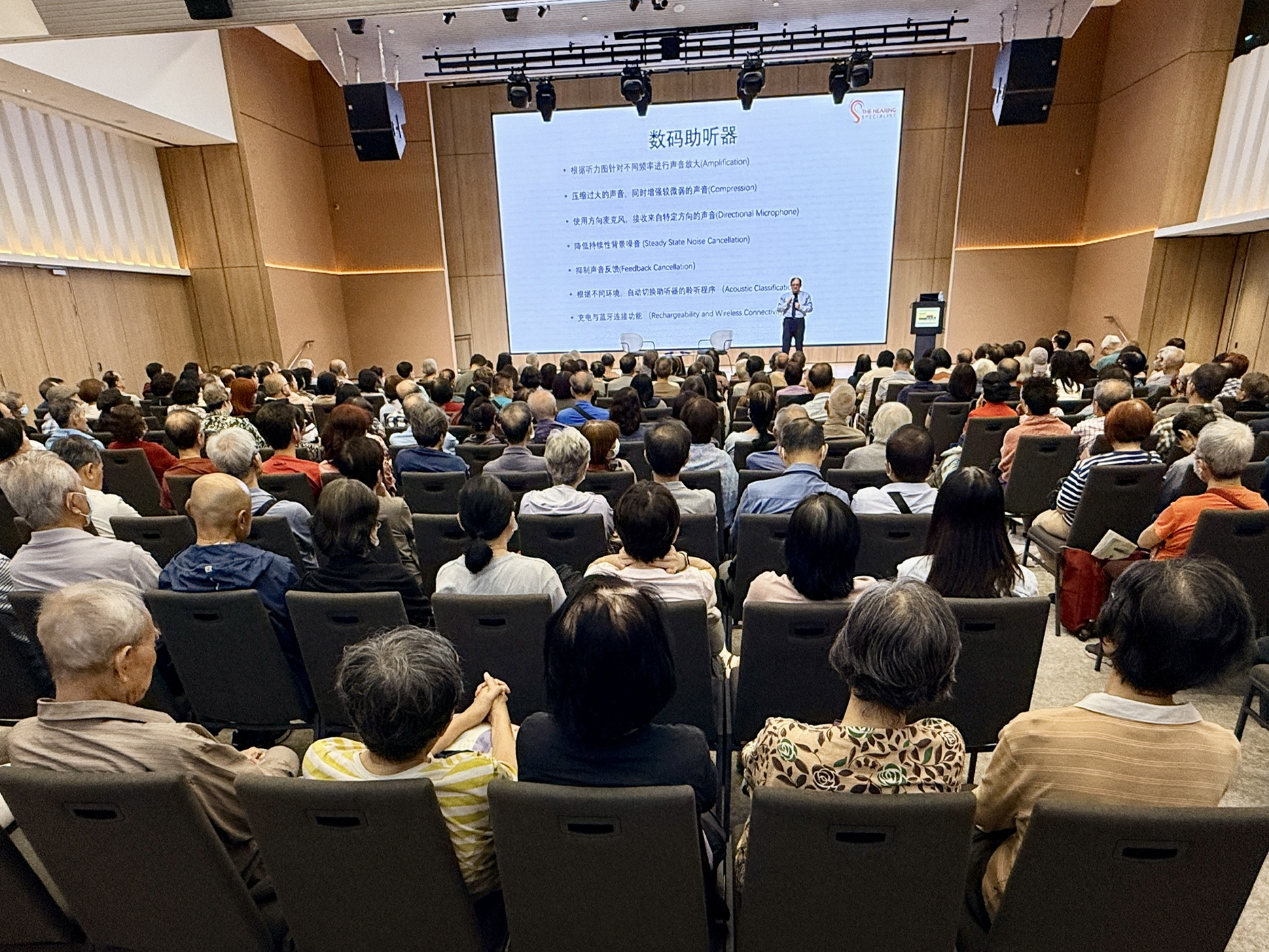
But before we explore how hearing care can help us in our later years, let us also consider another equally important question raised by an audience member at our recent Zaobao LOHAS Health Seminar 2026:
“As we live beyond 80 years old, what can we do to maintain our hearing?”
As more of us look forward to living longer, perhaps it is time to rethink what it means to hear well as we age.
1. Can We Maintain Good Hearing as We Grow Older?
While some people continue to enjoy relatively good hearing well into their 80s, others may experience noticeable hearing changes much earlier.
Our hearing abilities are influenced by a combination of factors, including genetics, aging, cumulative noise exposure, certain health conditions and medications.
Although age-related hearing loss cannot be completely prevented, there are practical steps we can take to protect our hearing and reduce avoidable hearing damage.
Be mindful of excessive noise exposure in our everyday environment.
Practise safe listening habits when using earphones and earbuds.
Look after our general health, including managing chronic health conditions such as diabetes and high blood pressure.
Make regular hearing assessments part of our healthy aging routine.
Seek professional advice when we notice changes in our hearing or ability to understand conversations.
Interestingly, several questions raised during the seminar related to something many of us use every day — earbuds.
How long can we safely use our earbuds?
It is not simply about the number of hours we spend wearing earbuds. What matters is how loud we listen, for how long and how much noise exposure we accumulate throughout the day.
According to the World Health Organization (WHO), the recommended weekly listening limit for adults at 80 decibels is 40 hours. At 90 decibels, however, this drops to just four hours.
A relatively small increase in perceived loudness can significantly increase our exposure to sound energy.
Keeping the volume low, taking regular listening breaks, monitoring sound exposure through smartphone features and using well-fitted noise-cancelling earbuds to reduce the need to turn up the volume are practical ways to protect our hearing.
Is wearing one earbud safer than wearing two?
Not necessarily.
At the same listening level and duration, wearing one earbud does not reduce the sound exposure experienced by the ear wearing it.
In fact, when using a single earbud in a noisy environment, we may be tempted to increase the volume to overcome surrounding noise.
Alternating between ears may distribute the exposure, but it does not eliminate the risk associated with excessive sound levels.
Rather than focusing on whether we should wear one or two earbuds, we should pay greater attention to our listening volume, duration and overall noise exposure.
It is not the use of earbuds itself that we need to be concerned about. It is how we use them.
The hearing habits we practise today can influence the hearing abilities we retain in our later years.
2. Hearing Well Is About More Than Having Healthy Ears
Did you know that even when we can hear sounds, we may not necessarily be able to make sense of them easily?
Hearing is a collaborative process involving both our ears and our brain.
Our ears receive sounds, while our brain processes, interprets and makes sense of the information received. When hearing becomes less clear, our brain may need to work harder to understand what is being said. This can make everyday conversations more mentally demanding and tiring.
Imagine having to concentrate intensely throughout a family dinner simply to keep up with the conversations around you.
What should be an enjoyable social experience may gradually become an exhausting one.
This is why hearing well goes beyond hearing health. It is also closely connected to:
– Cognitive processing and mental engagement
– Mental and emotional well-being
– Meaningful relationships and social connections
– Confidence in navigating everyday life
– Maintaining our desired level of independence
Research has also identified associations between hearing loss and cognitive decline, although the relationship is complex and involves many other factors.
As we grow older, caring for our hearing should therefore be seen as an integral part of caring for our overall well-being.
3. What If Our Hearing Has Already Changed?
Not all hearing loss is preventable, and most age-related sensorineural hearing loss cannot be reversed.
But that does not mean we have to accept increasing communication difficulties as an inevitable part of growing older. There is a difference between accepting that our hearing may change and accepting that nothing can be done to help.
The first step is to understand the nature of our hearing difficulties.
Are we struggling to hear softer sounds? Are we finding speech increasingly unclear? Is it becoming more difficult to follow conversations in noisy environments?
A comprehensive hearing assessment can help us better understand these changes and explore appropriate ways to address them.
The earlier we recognise and address our hearing difficulties, the sooner we can begin supporting better everyday communication.
4. Can Hearing Care Still Make a Meaningful Difference at 80 and Beyond?
Age alone should never be the deciding factor in whether someone can benefit from hearing care.
Instead, perhaps we should begin by asking what the individual wishes to continue enjoying in life.
Is it having meaningful conversations with their grandchildren?
Enjoying a coffee session with friends?
Following their favourite television programmes?
Communicating confidently with their doctor?
Or simply maintaining the independence to manage their everyday activities?
These aspirations do not become any less important as we grow older.
For many people with age-related sensorineural hearing loss, appropriately selected and fitted hearing aids remain the most established and effective hearing rehabilitation solution.
Advances in hearing technology have also opened up more possibilities for improving speech clarity, listening comfort and ease of use.
However, choosing a hearing aid is only one part of the journey.
Understanding the individual’s hearing abilities, cognitive and physical needs, lifestyle, personal preferences and communication goals is equally important.
Professional fitting, counselling, practical communication strategies, family support and ongoing care all play a role in helping individuals get the most out of their hearing solutions.
For some individuals, additional or alternative hearing solutions may also be appropriate.
It is not about how advanced the hearing technology is, but how meaningfully it can support the life an individual wishes to lead.
5. Hearing Well Is a Shared Effort
While professional hearing care and appropriate hearing technology play important roles, the people around us can make a meaningful difference too.
Simple adjustments such as speaking face-to-face, reducing competing background noise, speaking clearly and being patient can help make everyday conversations more accessible and enjoyable.
Family members can also support their loved ones by encouraging continued participation in conversations, social activities and the experiences they enjoy.
After all, hearing loss may affect one person, but communication involves everyone.
Living Longer. Hearing Well. Living Better.
We may not be able to prevent every change in our hearing as we age, but there is much we can do to protect our hearing, address hearing difficulties and support better communication throughout our lives.
Whether we are approaching 80 with relatively good hearing or already experiencing hearing difficulties, it is worth making hearing care part of our healthy aging journey.
Because the value of hearing well is not measured solely by how well we perform in a hearing test.
It is also reflected in the conversations we enjoy, the relationships we nurture, the confidence we retain and the independence we cherish.
Living longer gives us more years. Hearing well can help us make more of those years.
💛 Hearing is part of healthy living.
Beyond Better Hearing. Towards Better Living.
The Hearing Specialist Group