

October 15, 2026
Quote
“Hearing loss happens to an individual. Communication happens between people.” — could actually become the umbrella message for this family-focused series of sharing.
What Is “Noise” to Someone with Hearing Loss? It May Not Be What You Think.
“Dad, I know you can hear me.”
“You heard me perfectly in the car just now.”
“So why can’t you hear us at dinner?”
It can be confusing — and sometimes frustrating — for families.
A parent may communicate perfectly well with you when the two of you are sitting together in a quiet room.
Yet take the same person to a busy restaurant, family gathering or coffee shop and suddenly they are asking:
“What did you say?”
again and again.
They may complain:
“It’s too noisy.”
Or eventually become quiet and simply listen while everyone else talks.
Family members sometimes interpret this as selective hearing, lack of attention or even unwillingness to participate.
But there may be something very different happening.
Your parent may be hearing the sounds around them — but struggling to separate, organise and understand them.
And understanding this difference can completely change the way families think about hearing loss.
Hearing Loss Is Not Simply a Quieter Version of Normal Hearing
Most of us imagine hearing loss as turning down the volume on a television. If normal hearing is at volume 10, perhaps hearing loss simply means experiencing life at volume six.
But sensorineural hearing loss can be much more complicated.
Besides reducing the audibility of sounds, it can affect how clearly different sounds are distinguished.
This helps explain a comment Audiologists hear frequently:
“I can hear people talking. I just can’t understand what they’re saying.”
Making everything louder does not necessarily solve that problem.
In fact, when several sounds compete with one another, increasing the volume of everything can sometimes make the listening environment feel even more overwhelming.
So What Exactly Is “Noise”?
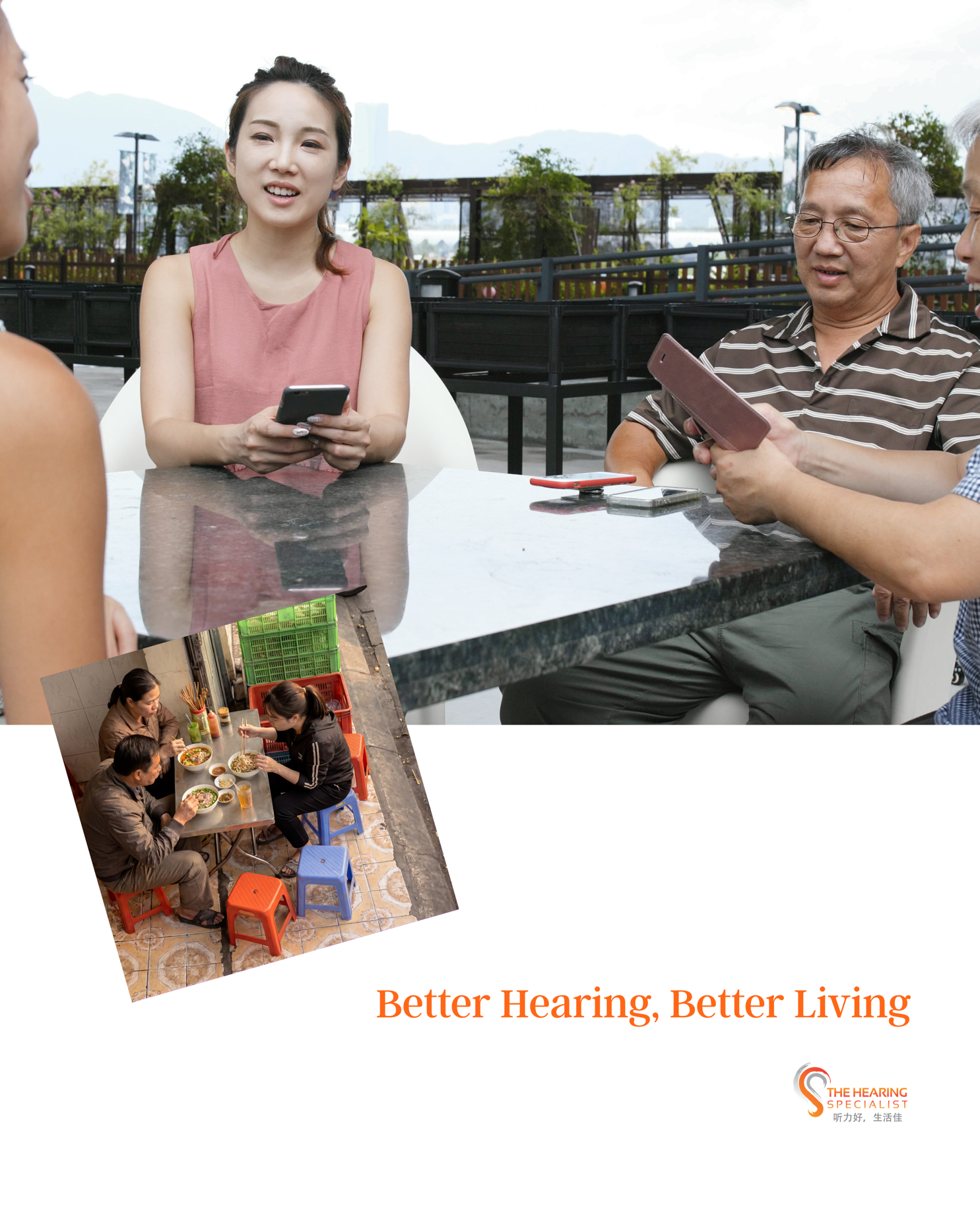
Imagine a Sunday family dinner.
Mum is sitting at the table.
Her daughter is speaking opposite her.
Two grandchildren are talking beside her.
Someone at the other end of the table calls her name.
The television is playing in the background.
Plates and cutlery are moving.
Several conversations are happening simultaneously.
For someone with normal hearing, the brain can often shift attention relatively effortlessly.
One moment you listen to the person opposite you.
Then your grandchild says something funny and your attention moves sideways.
Someone calls your name and you turn towards them.
Many sounds are present, but your auditory system and brain work together to help you focus on what matters.
For someone with hearing loss, that separation can become considerably more difficult.
Everything may begin competing for attention.
And that leads to an important point:
“Noise” is not simply loud sound.
It can be any competing sound that makes the sound you want to hear harder to understand.
The television may be noise while Mum is trying to hear her daughter.
But when everyone stops talking and Mum wants to watch her drama, the television is no longer noise.
A grandchild’s voice may compete with another conversation — but nobody wants technology simply to remove the grandchild.
What is important and what is unwanted can change from second to second.
That is why hearing in complex environments is such a difficult problem.
“Why Has Mum Become So Sensitive to Noise?”
Families sometimes notice another change.
Their parent begins saying restaurants are too noisy.
They turn down sounds other family members find perfectly acceptable.
They may avoid crowded places or become irritated when several people speak simultaneously.
It can seem contradictory:
If Mum has hearing loss, shouldn’t noise bother her less because she hears less?
Not necessarily.
Part of the answer lies in the difference between hearing a sound and processing a complex sound environment comfortably.
When speech information becomes less clear, the brain has fewer reliable auditory clues to work with.
It has to make greater use of context, attention, memory and prediction to work out what was said.
Imagine receiving a sentence with several letters missing:
“W_uld y_u l_ke s_me c_ff_e?”
You can probably work it out.
Now imagine doing that sentence after sentence, while several other incomplete conversations are happening around you.
That gives us a simple way of understanding listening effort.
The person isn’t necessarily “not listening”.
They may actually be listening much harder than everyone else.
The Brain Has Been Compensating Quietly
This is one of the less visible consequences of hearing loss.
When auditory information becomes incomplete, the brain continually tries to fill in what is missing.
It uses context.
It watches faces.
It predicts words.
It remembers what was said earlier.
It concentrates.
These strategies can work remarkably well — which is partly why some people do not realise how much their hearing has deteriorated.
But compensation requires effort.
After a long family gathering, the person with hearing loss may therefore feel much more tired than everyone else.
This is often called listening fatigue.
So when Dad says:
“It’s too noisy. Let’s go home.”
the problem may not simply be the volume of the restaurant.
He may be exhausted from trying to make sense of everything he is hearing.
Then Something Else Happens: We Get Used to Hearing Less
Hearing loss usually develops gradually.
That matters.
If someone’s hearing changed dramatically overnight, the difference would be obvious.
But when hearing deteriorates slowly over several years, the person adapts along the way.
Sounds that gradually disappear may stop being noticed.
Family members begin repeating themselves.
The television slowly becomes louder.
The person chooses quieter places.
They rely increasingly on visual cues.
And because these changes happen little by little, they can become the person’s new normal.
This helps explain something families frequently struggle to understand:
“We all notice Mum’s hearing problem. Why doesn’t she?”
It does not necessarily mean she is deliberately denying it.
Her brain has had years to adapt to the sound world she now experiences.
Why Hearing Aids Can Initially Sound “Too Noisy”
This also helps explain another common reaction when someone first tries hearing aids.
Suddenly, sounds they have not heard clearly for years become audible again.
Footsteps.
Running water.
Paper rustling.
Cutlery.
Traffic.
Air-conditioning.
Other people’s conversations.
The person may say:
“Everything is so noisy!”
Yet some of those sounds are perfectly ordinary sounds that people with normal hearing have been hearing — and automatically filtering — all along.
The difference is that the new hearing aid user has become accustomed to a quieter auditory world.
Now the auditory system and brain have to become reacquainted with a richer sound environment.
That adjustment takes time.
And it is one reason successful hearing rehabilitation involves more than simply putting hearing aids into someone’s ears.
Hearing Rehabilitation Is Not a One-Person Journey
Recognising and accepting hearing loss is an important first step.
Coming forward for a hearing assessment and appropriate intervention is another.
But successful hearing rehabilitation should not rest entirely on the person with hearing loss.
The family has a role too.
A hearing aid can improve access to sound, but it cannot control how quickly family members speak, whether three people talk at the same time, whether someone calls from another room or whether an important conversation takes place with the television playing loudly in the background.
This is where family understanding becomes part of hearing rehabilitation.
When families understand how hearing loss changes communication, they can begin making small but meaningful adjustments.
Get the person’s attention before speaking.
Face them when having an important conversation.
Reduce unnecessary competing sound where possible.
Avoid speaking from another room.
When several family members are together, try not to have everyone speaking over one another.
And perhaps most importantly, give the person a little more time to listen and respond.
These are small changes.
But together with appropriate hearing intervention, they can make communication considerably easier.
The Goal Is Not Simply Better Hearing. It Is Reconnection.
Hearing loss happens to an individual.
But communication happens between people.
That distinction matters.
Over time, untreated hearing difficulties can subtly change relationships.
One person becomes tired of asking for repetition.
Another becomes frustrated at having to repeat.
Conversations become shorter.
Jokes are missed.
The person with hearing loss participates less.
Family members gradually stop including them in certain conversations because they assume they will not hear anyway.
Nobody intends for this distance to develop.
But little by little, communication can change.
That is why hearing rehabilitation should ultimately be about more than improving hearing-test results or fitting hearing aids.
It is about rebuilding communication.
The person with hearing loss learns to understand their hearing difficulties, accept appropriate support and gradually adapt to hearing more again.
The family learns to understand why communication has become difficult and adapts the way they communicate.
Technology helps bridge the hearing gap.
Professional rehabilitation guides the adjustment.
And family understanding, patience and communication help bring people back into the conversation.
Perhaps this is the most important message for families:
When Mum says,
“It’s too noisy. I can’t hear what you’re saying,”
we don’t necessarily need to reply:
“But it’s not noisy to us.”
A better response may simply be:
“Let’s make it easier for you to hear us.”
Because ultimately, better hearing is not simply about hearing more sounds.
It is about keeping conversations going, relationships connected and the people we love part of the life happening around them.